Case study · Project year 2024
Automobile Insurance Fraud Detection
Heterogeneous graph neural network pipeline over claims, customers, and provider relationships.
My role: MSc thesis author; graph-ML development and evaluation in a business-unit study
Outcome
A hybrid HGFD + XGBoost model improved precision by 17.4% over the XGBoost baseline in a business-unit study.
Prioritizing claims for investigation
Fraud investigators have limited time to review claims. The engineering question in my MSc thesis was whether relationships between claims and related entities could improve the ranking produced by a tabular model. I developed and evaluated graph models alongside tabular baselines, and documented the work in the public thesis and repository.
The study concerns automobile insurance fraud in a business-unit setting. The public account here is limited to the published research; operational employer systems, customer records, and deployment details are outside its scope.
Why the final model is a hybrid
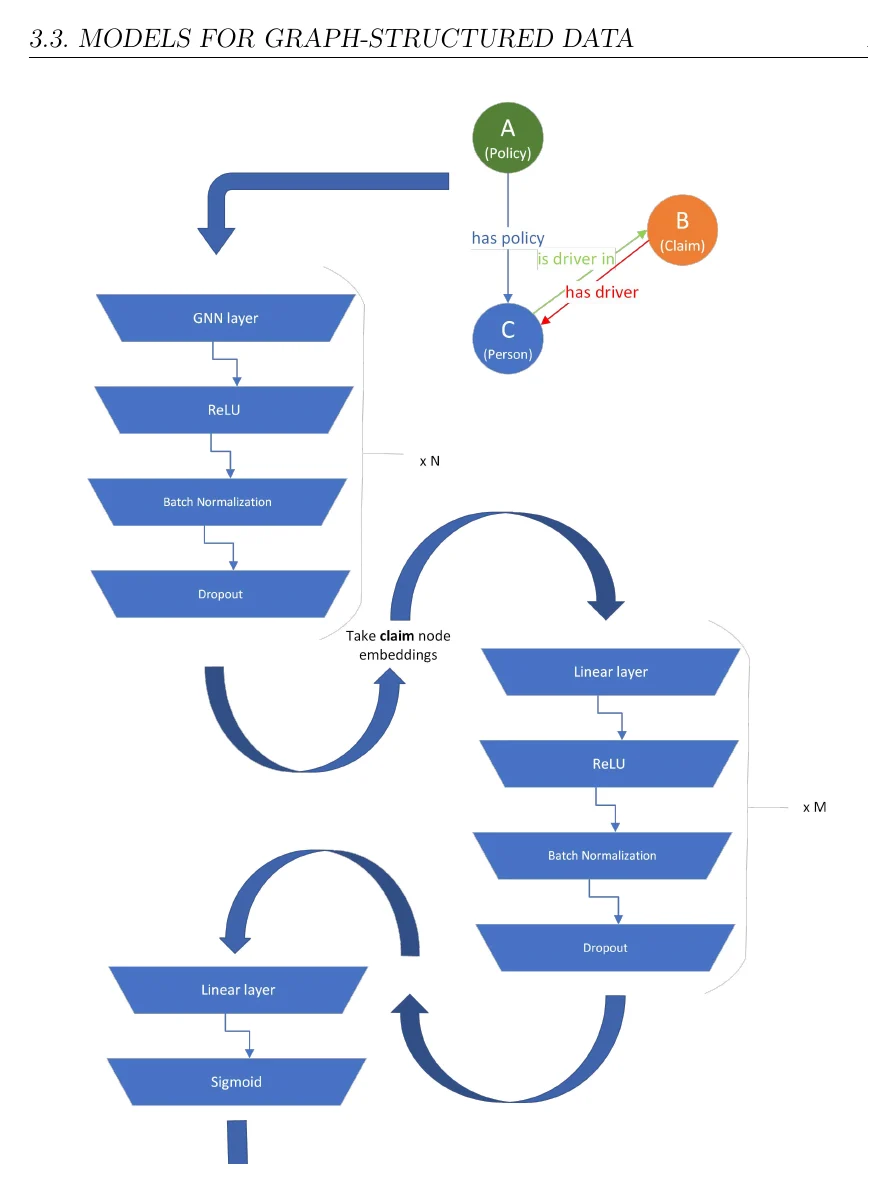
A heterogeneous graph represents several entity and relationship types, allowing HGFD to learn from connected information. XGBoost uses a tabular representation. The final hybrid averages the predictions from HGFD and XGBoost, combining their two views of the same task.
The graph model adds training cost and is harder to explain than the tabular baseline. Comparing both approaches mattered more than assuming the more complex model would win. The thesis also tested adding pseudo-labeled claims through self-training: calibration and precision deteriorated, so this was not treated as an improvement.
Evaluation design
The published evaluation uses a temporal hold-out: 70% training, 10% validation, and 20% testing. The last 100 days of claims were excluded because labels were not yet available. Keeping the split chronological was intended to avoid evaluating past decisions with future information.
The thesis compares ranking quality and probability quality through AUC, precision at different review volumes, area under the precision curve, Brier score, and calibration plots. Precision is relevant to the investigator’s queue: among the claims selected for review, how many are fraudulent?
Result and limits
The thesis reports a 17.4% precision improvement over XGBoost for the hybrid model. This is not a claim that HGFD alone improved accuracy by 17.4%, nor a claim of a 17.4 percentage-point gain. The result belongs to the published study, not a global production rollout.
The public repository makes the implementation inspectable, but the private claims data do not permit an independent public reproduction of the business-unit result. Different label delays, investigation policies, or claim populations would require a new evaluation. See Chapters 5–7 for the split, comparisons, and limitations.
Two views, one claim ranking
- 01
Related entities → HGFD
A heterogeneous graph produces a fraud probability for each claim.
- 02
Tabular features → XGBoost
The tabular baseline produces a second probability.
- 03
Average → review ranking
Average the two predictions; evaluate precision and calibration.
Technology focus
- Graph Neural Networks
- PyTorch Geometric
- Insurance ML
Evidence and further reading
Evidence reviewed . Project year is separate from this review date.
- Read the MSc thesis (PDF), Chapters 5–7 (opens in new tab)
Published 2024; temporal split on pp. 46–47, hybrid and limitations on pp. 65–67. Reviewed 6 September 2026.
- Inspect the AutomobileFraudDetection code (opens in new tab)
Public implementation; private business-unit data are not published.