Case study · Project year 2026
Spiaggia Oggi
Nationwide Italian beach discovery guide for finding and comparing named destinations with visible source provenance.
My role: Product builder; full-stack implementation and evidence-led data publication
Outcome
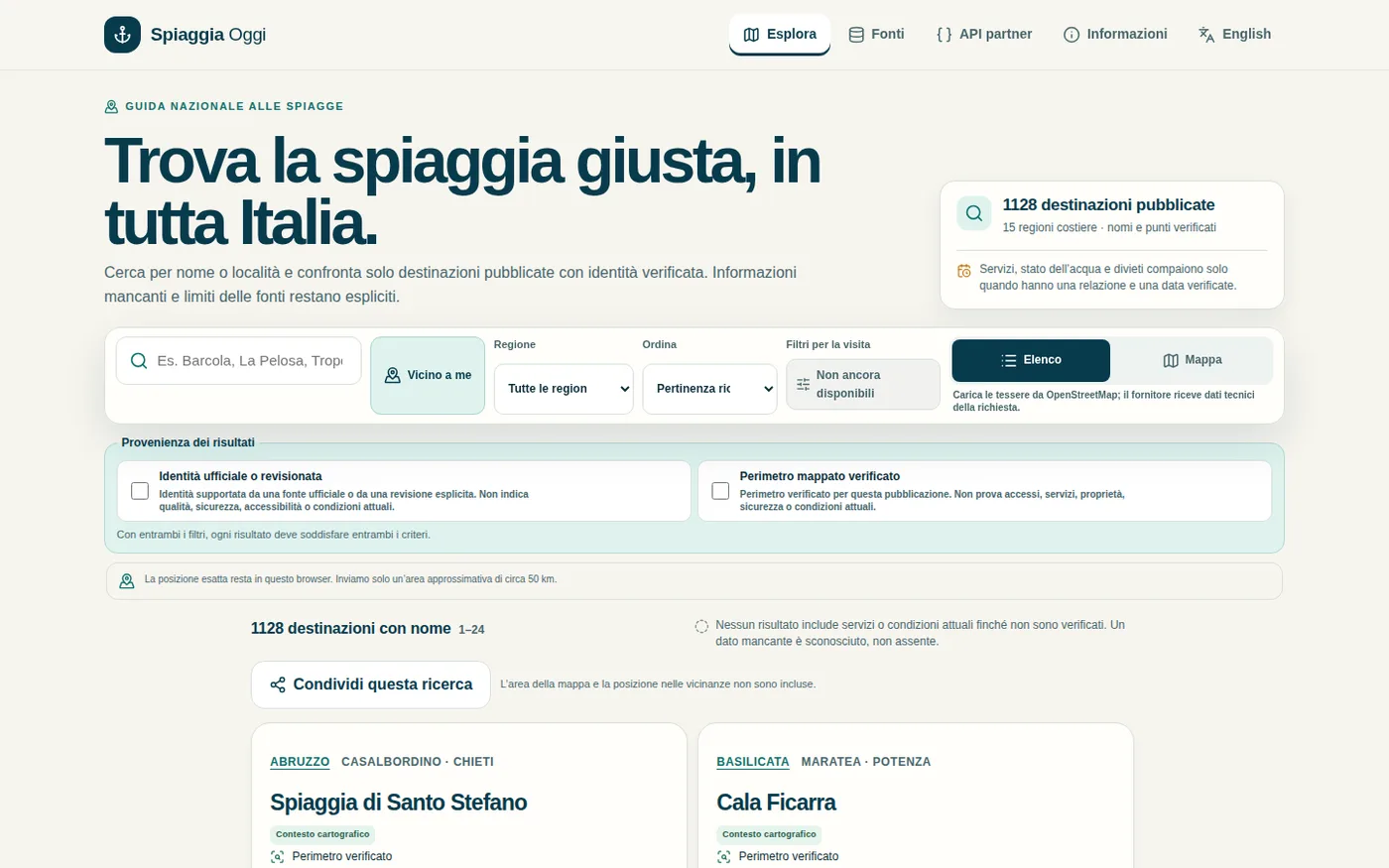
Published 1,128 named destinations across 15 coastal regions while keeping missing information and source limitations explicit.
Discovery without false certainty
Visitors need to find and compare named beaches, while the available source material often describes physical polygons, monitoring areas, or administrative records. Those entities are useful context, but they are not interchangeable with a visitor destination.
I built Spiaggia Oggi as an Italian beach discovery guide, working across the Next.js interface, PostgreSQL-backed destination data, and the publication rules that connect visible claims to evidence. The central product decision is to show the source and the unknowns alongside the destination.
Decisions that shape the guide
Destination identity and technical map context stay separate. A nearby monitoring area or physical polygon does not automatically establish a beach’s name, entrance, facilities, or current water conditions. Ambiguous matches remain out of the visitor guide until supported.
The public interface distinguishes mapped context from dated official evidence, and exposes missing conditions instead of presenting them as safe or available. This narrows what a visitor can infer from the map while making each entry more useful to assess.
The list is usable before loading the interactive map. Map tiles are loaded on request with a provider notice, and directions identify the representative point as distinct from a verified entrance. These choices keep basic discovery readable and make the limits of location evidence visible.
Validation and measured output
On 6 September 2026, the public explorer displayed 1,128 named destinations across 15 coastal regions. The check compared the total with the visible regional counts and inspected the source and missing-information labels on destination cards. This is a publication-coverage measure, not a measure of user benefit or completeness.
The public guide is evidence of the delivered interface and published coverage. It does not establish visitor numbers, booking conversion, or safer trips. Facilities, access restrictions, and current conditions need appropriately scoped and dated sources; a listed destination alone proves none of those facts.
From source material to a visitor claim
- 01
Source and identity
Keep named destinations separate from monitoring areas and polygons.
- 02
Publication checks
Require a supported relationship and date for a visitor-facing fact.
- 03
Guide and provenance
Publish the destination with sources, dates, and explicit unknowns.
Technology focus
- Next.js
- PostgreSQL
- Geospatial Data
Evidence and further reading
Evidence reviewed . Project year is separate from this review date.
- Explore the public beach guide (opens in new tab)
Coverage, regional totals, provenance labels, and map disclosure checked 6 September 2026.